A few weeks ago we were excited about the release of the TYT TH-UV88 radio. This "Baofeng killer" has taken the ham radio community by storm. With new radios, bugs are ALWAYS expected and the TH-UV88 is no different.
A few days ago a customer pointed out that they were having trouble with scan not receiving. We tested this with several radios and were able to confirm that there was indeed a problem. We made TYT aware of this and they immediately jumped in to action and had a solution within 24 hours!
The turnaround time was impressive, but maybe even more impressive is that a radio in this price range has upgradeable firmware!
A programming cable and a PC running Windows is needed for installation. The only change in this update is the scan fix, so if scan is not something you need or use, you do not need to install the update.
Installing the Firmware
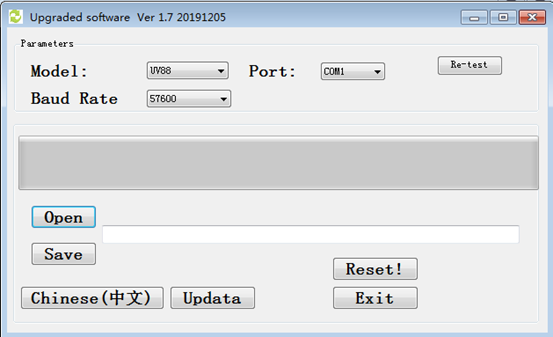
- Download the firmware update and extract the contents of the .zip file into a folder.
- Connect the radio to your PC using the programming cable.
- With the radio OFF, hold down the PTT button AND the top programmable side key (P1) while turning on the radio. Depending on your radio version the indicator light will be steady green or red to indicate the firmware is ready to update.
- Double-click the file named UV88_98_UpData.exe to launch the TYT firmware update tool.
- In the update tool, choose UV88 for the Model and 57600 for the Baud Rate. Also select the Port that corresponds to your programming cable.
- Click Open and select the file UV88_Eng_BQ1_25_20200430.hex, which was included in the .zip file.
- Be sure that you have plenty of battery life before starting the update, and do not power off the radio during the update!
- Click the Updata button to perform the firmware update.
- If an error occurs during the update, do not turn off the radio. Instead, close and restart the software, then click the Reset! button in the software. After the reset, try the update again.
A few days ago a customer pointed out that they were having trouble with scan not receiving. We made TYT aware of this, they immediately jumped in to action and had a solution within 24 hours! Here’s the fix.
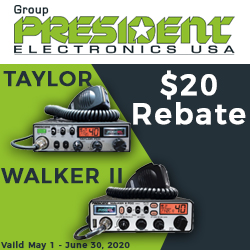 Purchase a President Taylor FCC or Walker II FCC CB Radio from Buy Two Way Radios and you can get a $20 Manufacturer Rebate! This is a great deal from President and is available for a limited time only!
This offer is fulfilled by President directly, so your $20 rebate check will be mailed to you after President receives your signed Taylor FCC Mail-in Rebate Coupon or Walker II FCC Mail-in Rebate Coupon. Be sure to download, sign and return the correct coupon for the product you purchase, along with your receipt or invoice from Buy Two Way Radios and the serial number of your new President CB radio to qualify. Offer limited to one (1) rebate per product, per person, household, family or address. Radio must be purchased new from an authorized dealer between May 1, 2020 and June 30, 2020.
NOTE: Rebate coupon must be postmarked within 30 days of purchase to qualify. Redemption submissions received after that date will NOT be eligible regardless of purchase date. All transactions are subject to validation. Offer is good to U.S. residents only and is void where prohibited, taxed or restricted by law.
Learn more about our full line of President CB and 10 Meter radios in our blog![related_products is_auto_added="1"]
Purchase a President Taylor FCC or Walker II FCC CB Radio between May 1 and June 30, 2020 and you can get a $20 Manufacturer Rebate. Read for details.
Updated May 7, 2025.
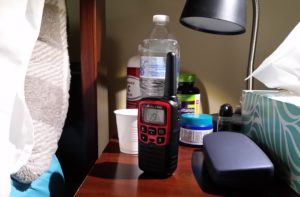 While we certainly hope this scenario isn't the case for you, it is an important one to address. In the event that someone in your family contracts a contagious illness and needs to be isolated within the home, you will need a way to communicate back and forth and monitor the situation while maintaining the necessary protocols of quarantine. This is a situation in which walkie talkies could prove to be an absolute necessity.
Isolating one or more family members within the confines of a home is not as simple as it sounds. It puts the entire family at risk. Studies have shown that a simple cough can eject micro droplets so small and light, they can hang around in a room with little or no cross-ventilation for hours, or even days. Even normal speech can distribute such micro droplets within a short distance from the speaker.
Considering this, the international recommendation for social distancing at a minimum of six feet or more makes perfect sense when in a public space. The problem is, the practice isn't always practical in a home environment. Since it is common for someone with an illness to be confined to bed in a room inside their apartment or home, the air in that room will fill with those micro droplets quickly, and unless there is plenty of cross-ventilation, those particles won't go away for a long, long awhile. While you should obviously provide care for the afflicted individual, it is also important to minimize unnecessary contact at the same time. You really don't want to go in there just to chat.
Staying at home to distance yourself from the rest of the world is one thing. Isolating someone from the rest of the household is a more complicated matter. Obviously, the less direct contact you have with this person, the better, but how can you do this and still communicate with one another?
The simple solution is to use radios. Using short range walkie talkies to communicate with an isolated individual can help everyone cope with the situation. Here are five ways walkie talkies can help when you're quarantined with an illness.
Radios can help the quarantined patient communicate with you.
The first and most obvious way to use these walkie talkies is to simply set one at the bedside of the patient in quarantine, and keep the other one for use by the caregiver(s) outside the quarantined area. When one party wants to talk with the other, just press the Push-To-Talk (PTT) button and, well, talk. Pretty simple stuff. And you can expand your communications from there. You can provide radios to everyone in every area of the home, so they can all practice proper distancing and assist with the home quarantine operations as needed.
Radios such as the Midland T31VP and Midland X-Talker T10X3M have a Call Alert or Call Tone feature that allows the patient to signal when he or she wants to talk. When the call button is pressed, the radio sends an audible alert tone to the other radios within range, much like when a phone rings to indicate a call is received and is waiting to be answered. Some radios have a single tone, while other models such as the Midland LXT633 may have 5 or more. The Midland X-Talker T75 has 10 selectable call tones, five of which are animal sounds!
Models like the Midland GXT1000 even have a whisper feature, which can give the quarantined patient the ability to call for assistance without having to raise their voice. This could be crucial, and can make deliveries of their food, water, and medical needs more efficient.
Walkie Talkies can assist with monitoring the quarantined patient.
If the patient is too sick or weak to physically operate a transceiver on their own, that patient will need to be monitored. This is anther area where walkie talkies may be able to help. The Midland T51VP3, Wouxun KG-705F, Wouxun KG-805F and many other radios include a feature called Voice Activated Transmit, or VOX. When VOX is activated, the radio will be in a "listen mode" and automatically transmit any sound picked up by the microphone to the other radios. For instance, if the patient calls out for assistance, it can activate the radio to transmit. In this way the radio can be used hands-free.
There are some caveats to this. VOX doesn't just activate by voice. It can be activated by any noise it picks up, any noise at all. If the patient is in a very quiet room, it may not be an issue. However, if there is anything else in the room that can generate noise, such as a TV, cell phone, or fan, it could be problematic, as the noise generated by any of those devices could also trigger the radio to transmit. This can sometimes be mitigated by adjusting the sensitivity settings for VOX in the radio, but will require quite a bit of trial and error.
Also, there is usually a delay between the moment the sound is emitted and the time it takes for the radio to hear the sound and begin to transmit. This could be up to several seconds, depending on the radio, the VOX circuitry, and its setting. The delay can result in the first part of a transmission being clipped and not heard by the recipient. This is normal and can sometimes be minimized somewhat by playing around with the VOX sensitivity settings, but not entirely eliminated. It's not a perfect science, but it is possible to use VOX to monitor the audio in a room in certain circumstances and under the right conditions.
Radios can help you communicate with everyone else inside and outside the quarantined area.
Walkie Talkies allow everyone in the home to be separated and keep it all together at the same time, both figuratively and literally speaking. When one person or group is required to remain separated from another, walkie talkies keep everyone in both groups communicating in order to co-ordinate and maintain the necessary parameters for distancing within the domicile. This is especially important, as it can help to avoid cross contamination between the assigned spaces of those who are ill and those who are not.
Radios can transmit fast, instant alerts to the entire household.
Need to send an urgent message or alert to others in the home while avoiding direct contact with them? Walkie talkies can do that, too. The Wouxun KG-705F and KG-805F are equipped with an emergency alert feature that allows you to signal everyone within range of an urgent matter or situation that requires their immediate attention. This can be especially useful if the quarantined patient takes a turn for the worse and needs medical attention or a trip to the hospital. It is important to understand that the emergency alert feature is not a substitute for calling 9-1-1 and it should not be misconstrued as such. It is not connected to any emergency system. It is merely intended for sending an alert to other family members in the household who are monitoring the patient that he or she may be in some distress or in urgent need of assistance.
Radios can provide a measure of comfort and security for the patient.
Let's face it, when someone is sick, they aren't just physically ill. The effects of quarantine and confinement is also an emotional and mental strain. The isolation can bring on feelings of loneliness and depression, which only adds to the physical discomfort or pain. Simply having a radio by the bedside can actually be psychologically beneficial, because they know can can call instantly, at the mere push of a button, and someone else in the household is likely to respond in kind. It symbolizes that even though no one can be in the same room, next to them, someone is nearby, monitoring them, and they are not truly alone. That is a very powerful and positive message, transmitted by the mere presence of a radio, without even pushing a button.
It is our hope that everyone currently stuck at home or quarantined with an illness recovers completely and quickly so they can all resume their normal activities of life. However, if you do find yourself or your family in isolation, there are ways to help ease the stress of confinement, improve the quality of caregiving, and mitigate the risk to others by using reliable and efficient two way radio communications. Buy Two Way Radios can provide you with the guidance and recommendations needed to do this safely, effectively and at minimal cost.[related_products is_auto_added="1"]
Staying at home to distance yourself from the rest of the world is one thing. Isolating someone from the rest of the household is a lot more complicated. Here are five ways walkie talkies can help.
Updated May 9, 2025.
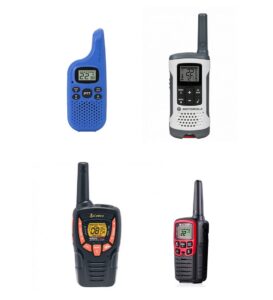 There are many different ways you can use two-way radios or walkie talkies to make life easier and less stressful, especially when you're stuck at home or during an emergency such as a shelter-in-place scenario. If you are stuck at home for an extended period of time, we would like to share some of the ways you can use two-way radios to make your situation safer, more efficient, and maybe even a little bit more enjoyable. Here are three ways walkie talkies can help when you're stuck at home.
Two-way radios can provide quick and easy communication between family members throughout the house. Maybe you are WFH or working from home in a secluded area of your domicile for privacy, and your spouse wants to let you know that lunch will be ready in a few minutes. A pair of handheld FRS radios such as the Midland X-Talker T31VP can quickly and easily accomplish this feat with minimal interruption, and without having to take anyone's eyes off the kids. Perhaps a stay at home mom or dad need a break, so they send the kids outside to play in the yard to enjoy a day of no school and beautiful spring weather. When play time is over, calling them back inside for their studies or for a meal is a breeze with a small walkie talkie like the T10 in tow!
 Walkie talkies can be used as a source of entertainment for both children and parents alike! For most kids, getting stuck at home for more than a day can get old, and cabin fever sets in. Many begin to miss their neighborhood pals and play dates. In such a situation, a set of FRS radios such as the Midland X-Talker T10X3M may help kids stay in touch with their friends nearby. The T10X3M radios are available in a convenient and economical three pack, each with a different color, so each kid can be assigned their own color coded radio. We realize that there are many different technologies out there to keep kids connected, but one of the advantages of using such a radio system is that it won't bog down the bandwidth while mom and dad are working remotely. Plus, the radio airwaves are free to use! Ultimately, it's a win/win for both sides!
Even though FRS radios may be license-free, easy to use, and cost-effective, they aren't mere toys, and they aren't just for kids. Take the X-TALKER T71VP3, for instance. This general purpose radio is also designed for emergency use, with 10 weather channels and NOAA weather alerts. The ease of instant push-to-talk communications over free airwaves make these and other FRS walkie talkies very efficient and cost effective for entire families to communicate with neighbors down the street at anytime, for just about anything. And it does all of this without monthly fees or residual costs!
Buy Two Way Radios is here to help with your quarantine needs, and even though our sales staff is also working remotely, our warehouse is still up and running with no delays on shipments. Please feel free to give us a call at 1-800-584-1445, and we will be happy to answer any questions you may have. Thanks, and stay safe![related_products is_auto_added="1"]
There are many different ways you can use two-way radios or walkie talkies to make life easier and less stressful during the 2020 pandemic. Here are three.
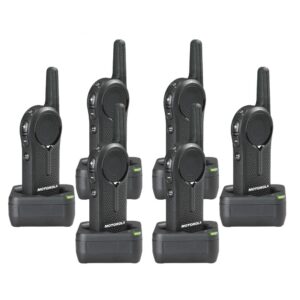 As we've mentioned in previous articles, podcasts and videos, the Motorola DLR1020 and DLR1060 radios can be great assets for many different types of businesses. In this article, we will note some of the many pros, as well as the few cons, that these radios have.
One of the biggest pros of the Motorola DLR series radios is that they operate on 900 MHz digital frequencies. This feature is beneficial in several ways. First, consider the level of privacy that these frequencies offer. The 900 MHz frequencies are much less common than standard UHF or VHF frequencies, and the FHSS "frequency hopping" method used by these radios allows you to completely eliminate any chance of unwanted interference from neighboring two-way radio users.
Second, these 900 MHz radios do not require any type of FCC licensing. This saves you hundreds of dollars in licensing fees and allows you to use the radios as-is, "out of the box", with minimal, if any, programming required.
Third, because the DLR series radios are digital, the sound quality is impeccable. You will find that there is no background static or "white noise" like you may experience with normal analog radios.
Another major plus is the ultra-compact size of the Motorola DLR radios. They are very small and incredibly lightweight, making them practical for use in almost any situation. Even with their small size and light weight, these units offer military-grade specs for durability and resistance against dust, water, vibration, shock, and extreme temperature variations. Like many of the other Motorola onsite business radios, the DLR radios have antimicrobial housings to inhibit the growth of mold and bacteria.
With all the pros, there are also a few cons. One disadvantage of the Motorola DLR radios is their low power. The transmit power of radios that operate on this 900 MHz band is limited to 1 watt by the FCC. This means they are not practical for very large industrial job sites. Also, the FHSS frequency hopping technology will not work with typical repeaters, limiting the possibility of extending their range.
Perhaps the biggest con would be the lack of cross-compatibility with an existing fleet of two-way radios operating on standard business frequencies. Based on their rather unique frequency hopping capabilites and the fact that they operate on 900 MHz frequencies instead of the UHF or VHF business bands, they are not universally compatible with other digital radios. Also, most companies still tend to use analog radios, which these digital units will not communicate with at all. The Motorola DLR technology is cross-compatible with only one other line of radios, the Motorola DTR series.
On the plus side, if you happen to already have Motorola DTR series radios such as the DTR600 or DTR700, the DLR line will work with them and will be a much sleeker, smaller, more affordable option.
With all this being said, the pros of the Motorola DLR1020 and DLR1060 radios far outweigh the cons, and tend to be an excellent option for almost any on-site business use!
[related_products is_auto_added="1"]The Motorola DLR1020 and DLR1060 radios can be great assets for many different types of businesses. In this article, we will note some of the many pros, as well as the few cons, that these radios have.
Updated May 9, 2025.
Many businesses adjusted their business practices during the 2020 pandemic to help limit direct contact with their customers. It wasn't long before both companies and their customers realized the advantages of offering curbside pickup as a value added service. Now, curbside service is commonly accepted as just another part of doing business. That's great for retail point of sale, but what about businesses that don't sell directly to the public?
Whether random sales solicitations or scheduled meetings with vendors and account managers, all businesses have to deal with visitors. We're hearing from businesses that are looking for solutions to help throttle these visitors so that they can be checked or tested, or just so that employees will have time to prepare themselves before greeting them. We have found that business handheld radios and two-way callboxes are perfect for this task of vetting visitors!
An outdoor callbox, such as the Ritron Q1 Series Two-Way Radio Callbox, can be permanently mounted outside of your building for safe and simple use. An arriving visitor will simply press the "Call" button to speak, and their message will then be relayed to employees indoors, who can then talk back to the visitor or open the door and allow entry. These units are weatherproof, easy to use, and can easily be sanitized with disinfectant spray or wipes after each use.
Callboxes can be programmed to communicate with other indoor units, such as the Ritron Jobcom 7 Series Two-Way Radio Base Station/Intercom. They can also be used to communicate with a handheld radio, such as the Icom IC-F4001 or Motorola CP-100d. If your business already utilizes a two-way radio system, we may even be able to program these callboxes to integrate with your existing units! As always, we offer free programming on any radio that you purchase from us, so it will arrive fully ready to "plug-and-play".
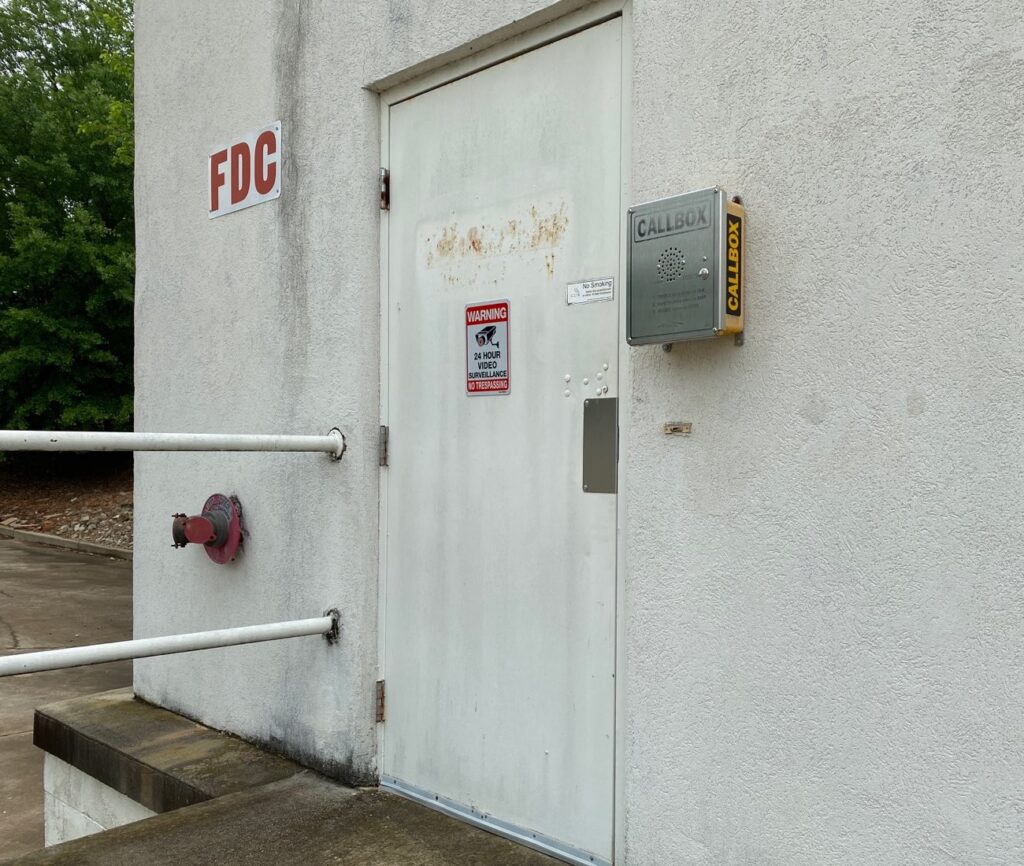
We have found that callboxes can be extremely beneficial in a warehouse environment as well, especially when multiple drivers per day are dropping off or picking up deliveries. The Ritron HD Series Heavy Duty 2-Way Radio Callbox is perfect for this. This unit can be mounted outside near delivery bay doors, and incoming drivers can quickly alert your warehouse staff on their handheld radio that a truck has arrived. They can do all of this while avoiding any direct contact with one another. The HD series callboxes are ultra-durable, weatherproof, and can also be sanitized after each use to ensure driver safety.
These are just a few examples of how using callboxes can help your business run efficiently, but the possibilities are endless. Keeping your employees and others safe is crucial, and we hope this gives you some ideas on how to achieve this. If you have any other questions about these callboxes, or any of our other products, please feel free to give us a call. Our sales staff is available at 1-800-584-1445 from 9 AM to 6 PM weekdays to ship your order directly from our warehouse as needed.
Download this pdf and learn how Motorola CLS and DLR radios plus callboxes can increase efficiency and enable social distancing in your business!
[related_products is_auto_added="1"]Need a way to vet visitors who need to enter your business? We explain how radios and callboxes can work as a solution to this problem.
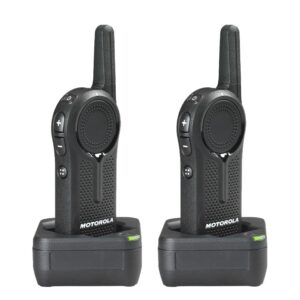 The Motorola DLR series radios are an excellent choice for businesses that want a high-quality digital radio with excellent privacy features. These radios also operate on 900 MHz digital frequencies, which means they can be used legally without applying for an FCC license!
The DLR series radios are ultra-compact, lightweight, and offer crystal-clear communication. They also use FHSS "frequency hopping" technology, which gives you a much higher degree of privacy from outside interference generated by neighboring businesses that may also be using these radios. Built to military-grade specifications for shock, dust, and water resistance, the Motorola DLR series radios are very versatile, and a great addition for almost any type of business.
If you've decided the DLR series is right for you, your next task is to decide on a model. This series offers two options: the DLR1020 and the DLR1060. What are the differences between these two radios? Well, there are really only two, and for the most part, the model you choose depends on how many channels you need.
The DLR1020 is the base model in the DLR series, and offers 2 channels. For most small, single location retailers and mom-and-pop type stores with simple operations and just a few employees, this is likely all you really need. The DLR1020 is priced at $209.00.
For larger restaurants, retail operations, and businesses that need more channel groups, the DLR1060 model supports up to 6 channels. This allows you to assign a dedicated channel to different departments, such as front clerks, stock clerks, managers and maintenance personnel. The DLR1060 is priced $10 more than the DLR1020, at $219.00.
Other than the number of channels and the price, there is no difference between these models.
Need more than 6 channels? Move up to the Motorola DTR series![related_products is_auto_added="1"]
What are the differences between the Motorola DLR2010 and DLR1060? Well, there are really only two, and the model you choose depends on what you need.
The current Covid-19 pandemic is testing the resolve of the entire world. Two way radios, and particularly amateur, FRS, GMRS and emergency weather radios are suddenly in high demand, so much so that it is becoming increasingly difficult to keep some of them in stock. Why the sudden surge in personal and emergency radios?
In this short clip from episode 148 of our long-running, award nominated podcast, The Two Way Radio Show, Danny, Anthony and Rick discuss this uptick in interest for these radios and its significance within the new reality of the Covid-19 pandemic.
[related_products is_auto_added="1"]In this short clip from episode 148 of our award nominated podcast, The Two Way Radio Show, Danny, Anthony and Rick discuss the uptick in interest for emergency radios during the Covid-19 pandemic.
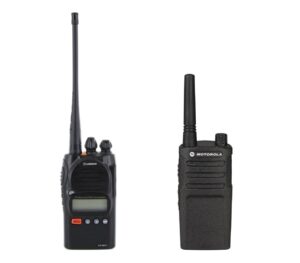 When searching for a two way radio to fit a particular terrestrial activity or application, it generally comes down to a choice between either a business or consumer grade model. Each category is intended for use on a specific radio service, and each has its own advantages and limitations. Fortunately, there is one category that has all the best qualities of both. We're talking about the MURS.
The Multi-Use Radio Service, or MURS, is a rather unique radio service that is usually overlooked, quite underused and greatly underrated. There are five MURS frequencies, all reserved on the VHF band for business, personal or recreational use at up to two watts of power, and without a license. MURS is license-by-rule, meaning that simply owning and operating an FCC type accepted MURS radio gives you the license to use it.
Now, two watts may not seem like a big deal, but it's actually a fair amount of power when applied to the VHF band. And as any seasoned radio operator knows, when it comes to maximizing range, wattage is not what really counts anyway. It's the antenna and where it's positioned within line-of-sight that makes all the difference. This is an important point to consider, because MURS allows for detachable and external mount antennas. You can hear All About MURS on our podcast, The Two Way Radio Show.
If MURS is so great, where are all the MURS radios? Good question. As mentioned before, MURS is often overlooked for a multitude of reasons, and most are market driven. But that doesn't mean they aren't out there. On the contrary, a number of MURS radios do exist, and in several different forms. There are handheld models, base stations, Intercoms and Callboxes and even a PA System available for MURS. With this eclectic selection, the question now becomes, which is the best MURS radio?
Of course, the best form factor largely depends on your application, but as far as portable handhelds go, it's really no contest. Here are our picks for best MURS radio.
Best Value MURS Radio
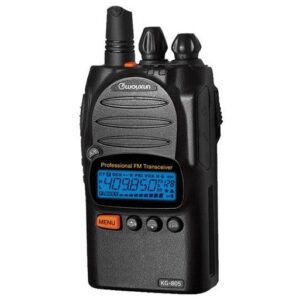 The Wouxun KG-805M is our winner for the best value MURS radio on the market. Introduced in 2019, it's also a fairly new model. It has five channels programmed with all five MURS frequencies and transmits at a full 2 watts, the maximum for the MURS. It sports a backit LCD display with an option to choose one of three backlight colors, which can be customized for transmit, receive or standby modes. The keys are also backlit for operation at night or in poorly lit areas.
The KG-805M features 155 CTCSS tones and DCS privacy codes, channel scan, a built-in FM radio, channel name edit and display, and VOX. The 805M can also be programmed from a PC to receive NOAA weather channels and for other advanced customization. It's rated IP55 for dust and water, which means it's a fairly tough little radio for use in the field.
As an added bonus, the antenna is also removable! This is a powerful advantage over other handheld MURS radios with fixed antennas, as it allows the operator to swap out with the stock antenna for another to optimize range or possibly even to attach an external antenna to considerably increase it.
Overall, the Wouxun KG-805M is a solid MURS radio, and it's packed with features at a cost that is both advantageous for businesses and affordable for the average consumer. For these reasons, we consider the KG-805M to be the best overall value MURS radio out there. Price: $79.99
Best Overall MURS Radio
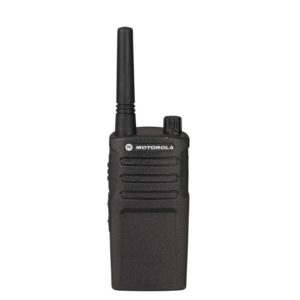 The Motorola RMM2050 gets the award for best overall MURS radio currently available. Designed specifically for on-site business operations, the RMM2050 offers great audio and excellent range on VHF. It has five channels and the maximum 2 watts of power, a multi-color LED indicator, and two programmable buttons. It features three audible call tones, hands-free VOX mode, three voice-inversion scramble codes, and channel announcement with voice alias.
The RMM2050 is programmable and can be easily cloned with an optional cloning cable connected to the charger. It's also one of the toughest MURS radios around, with an IP54/55 rating and built to meet MilSpec 810 standards for shock, rain, humidity, salt fog, vibration, sand, dust, and temperature. As with many other radios in the Motorola RM Series, the RMM2050 also includes antimicrobial protection. Want a closer look at this model? Watch our Motorola RMM2050 unboxing video!
If it looks somewhat familiar to longtime MURS users, that's because it is. The RMM2050 is the successor to the classic RDM2020. While a bit pricier than the Wouxun model, Its tough exterior and excellent quality sound is well worth the investment. Price: $189.00[related_products is_auto_added="1"]
When searching for a two way radio to fit a particular terrestrial activity or application, it generally comes down to a choice between either a business or consumer grade model. Each category is intended for use on a specific radio service, and each has its own advantages and limitations. Fortunately, there is one category that […]
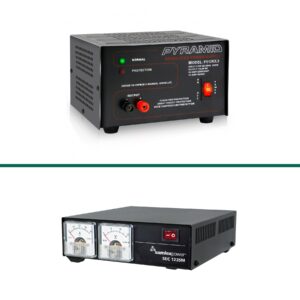 You want your mobile two way radio on your desktop, or you want to convert it into a base station for your shack. You've picked out radio, the antenna, and location for your rig. All you need is the power supply. There's just one minor detail. You know exactly how much power you need, but what type of power supply should you choose?
There are several types of power supplies. These include those that are unregulated, ripple regulated, regulated linear and switching. In this article we are going to focus on comparing the two types we carry at Buy Two Way Radios for use with our mobile and base station two way radios. These two types of power supplies are Linear (regulated) and Switching.
Linear Power Supplies
Linear power supplies have been around for a long time. At one point it was the only choice for power supplies. They produce clean, quiet DC voltage with little to no electromagnetic noise. This makes the linear power supply a great choice for use in radio communications. A linear power supply takes the AC line voltage and puts it through a transformer to lower the voltage, then a through a rectifier and filters to convert it to DC output voltage.
Linear power supplies are well suited for use with radios, but they do have a few drawbacks. The large transformers and filter circuits generate a lot more heat, which in turn requires large heat sinks to compensate. Due to all these components, they are also quite heavy. The more power they provide, the heavier and larger they become. In addition, their energy efficiency is fairly low compared to a switching power supply.
Switching Power Supplies
Switched Mode or Switching power supplies are smaller, lighter and more advanced. They also operate at considerably higher efficiency than a linear model. Switch power supplies also generate less heat, which can be an important advantage when operating in a small ham shack or in an area with limited air circulation.
The drawback to switching power supplies is that they can introduce RFI noise. This can be a problem with inexpensive, lower quality models and small, "brick" style power supplies intended for general consumer electronics, but is not generally an issue with power supplies intended for radios and built by high quality, name brand manufacturers. Even so, the noise can be sometimes be alleviated by using EMI chokes or ferrite cores on external wiring to the radio.
Before you shop around for power supplies, it is important to know that they are not all the same. It can make all the difference between choosing the right power supply for your radio, and not having all the power you really need.[related_products is_auto_added="1"]
You want your mobile two way radio on your desktop, or you want to convert it into a base station for your shack. You know how much power you need, but what type of power supply should you choose?