If you've ever looked at the specifications for a two way radio, you've probably seen the term "superheterodyne receiver". Some radios even advertise having a dual conversion or triple conversion superheterodyne receiver. But what exactly is a superheterodyne receiver, and why is it important?
In this episode of Radio 101, Tommy explains what a superheterodyne receiver is, how it works and the types of radios that use them.
Want more videos about 2-way radios? Browse our video blog and subscribe to our YouTube channel!
[related_products is_auto_added="1"]
If you’ve ever looked at the specifications for a two way radio, you’ve probably seen the term “superheterodyne receiver”. Some radios even advertise having a dual conversion or triple conversion superheterodyne receiver. But what exactly is a superheterodyne receiver, and why is it important? In this episode of Radio 101, Tommy explains what a superheterodyne […]
Prepare to trick or treat with a frightfully good deal at Buy Two Way Radios! Buy a Wouxun KG-S88G Plus GMRS radio and get $20 off the regular price!
Two way radios are a spooktacular way to keep your family connected, safe and secure while haunting the neighborhood on Halloween. With a Wouxun KG-S88G Plus in your clutches, you can stay in touch with your group of ghouls without relying on a cell phone. It's a wickedly useful way to communicate when things go bump in the night!
And here's the real treat! Normally $129.99, the Wouxun KG-S88G Plus is now just $109.99 during this hair-raising Halloween sale! No tricks, no promo codes, and no terrifying purchase limits. Just choose your favorite color(s), toss as many radios as you dare into your shopping cauldron, and conjure up some monstrous savings! It's a deal so good, it's scary!
But beware! This undead discount is only living for a limited time! Our Halloween sale rises from the grave on October 19, 2026, and returns to dust at midnight on October 31, 2026, EDT. Once the clock strikes twelve, this ghostly bargain is gone!
Don't be caught dead paying full price! This frighteningly phantasmic offer is available only while supplies last. So summon your friends, gather your ghouls, and sink your fangs into a Wouxun KG-S88G Plus from Buy Two Way Radios before these scary savings disappear into the shadows forever![related_products is_auto_added="1"]
Prepare to trick or treat with a frightfully good deal at Buy Two Way Radios! Buy a Wouxun KG-S88G Plus GMRS radio and get $20 off the regular price! Two way radios are a spooktacular way to keep your family connected, safe and secure while haunting the neighborhood on Halloween. With a Wouxun KG-S88G Plus […]
One of the most misunderstood buttons on a handheld radio is the Monitor button. Most portable handheld two way radios include a Monitor function of some sort, but many users are unsure of its actual purpose, or if it is even useful at all. So, what is it and why would you use it?
In this episode of Radio 101, Tommy explains the purpose of the monitor button, how it works and how to use it when operating your portable handheld two way radio.
Want more videos about 2-way radios? Browse our video blog and subscribe to our YouTube channel!
[related_products is_auto_added="1"]
One of the most misunderstood buttons on a handheld radio is the Monitor button. Most portable handheld two way radios include a Monitor function of some sort, but many users are unsure of its actual purpose, or if it is even useful at all. So, what is it and why would you use it? In […]
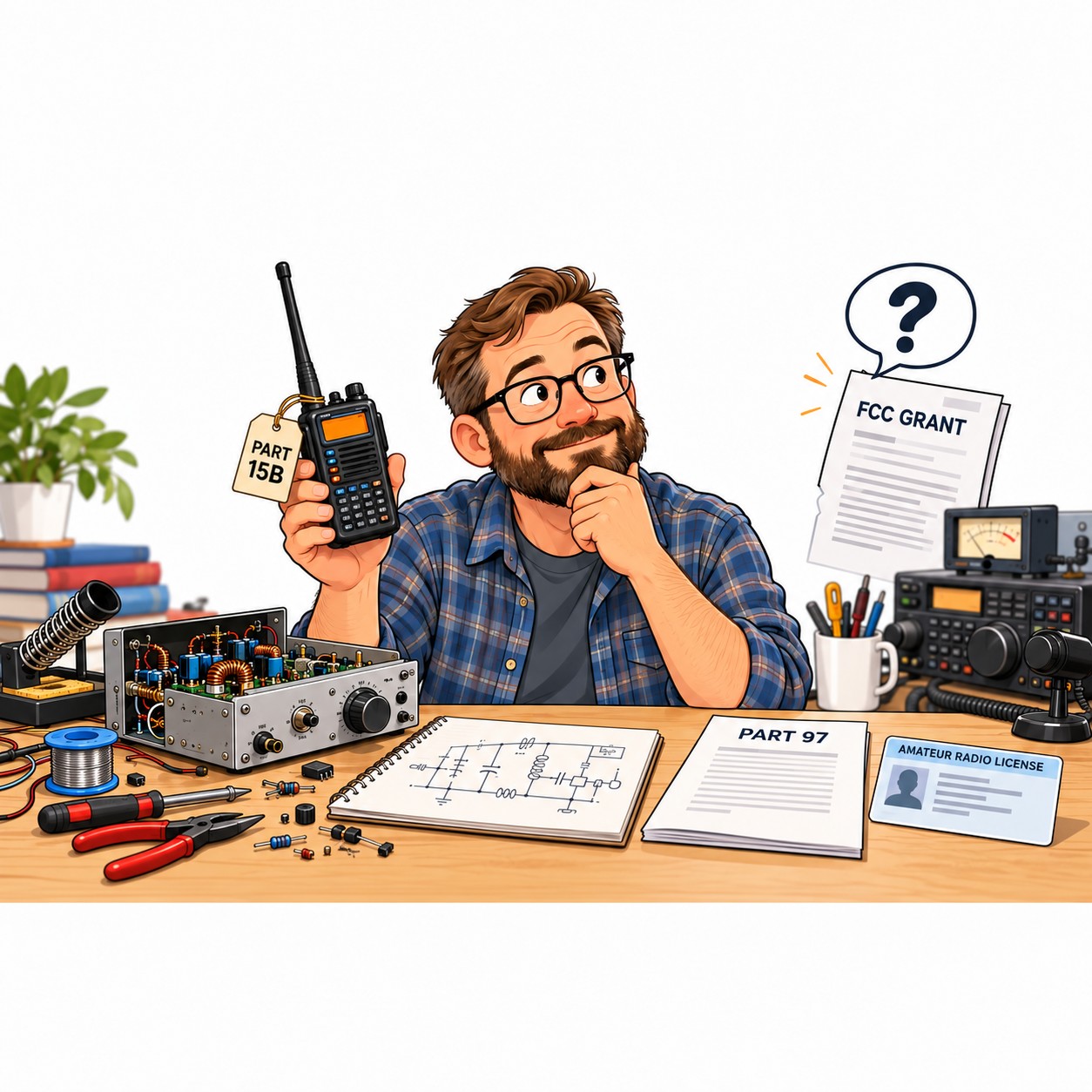 If you look up the FCC ID on an amateur radio, you may find a grant that lists Part 15B but says nothing about Part 97. That can seem strange. The radio transmits, and Part 15B does not authorize its amateur transmissions. Check the sticker on the back of the radio and there is no FCC ID for it, either. So where is its Part 97 approval?
The short answer? There isn’t one. Why?
Part 97 is the section of the FCC rules that governs the Amateur Radio Service, but amateur transceivers generally do not need FCC equipment certification for their transmitters. This is different from services such as CB, FRS or GMRS, where the rules require one.
The reason is surprisingly simple. Amateur radio is a hobby service, and as such, has long allowed licensed operators to build, modify and experiment with their own equipment. Requiring every transmitter to receive an individual equipment grant would be at odds with that practice.
It gets better. A licensed ham can even use a radio originally made for another service on amateur frequencies, provided the station’s operation complies with the amateur rules. The absence of a Part 97 entry on an FCC grant does not mean the radio cannot be used on the ham bands.
Of course, this doesn't mean amateur transmissions are exempt from technical rules. On the contrary, Part 97 specifies the frequencies, emissions and operating limits that an amateur station must follow. The control operator is responsible for the station’s transmissions, including keeping unwanted emissions within the applicable limits. An FCC ID alone does not establish that every possible setting or modification of a radio meets those requirements.
So what does Part 15B certification mean on the grant? Part 15B concerns unintentional radio frequency emissions from equipment such as receivers and digital circuitry. An amateur transceiver may have a Part 15B authorization for those functions, even though its amateur transmitter doesn't require a separate Part 97 equipment grant to operate. The point is, Part 15B does not authorize transmission on the amateur bands. The authority to operate an amateur station comes from the operator’s license and compliance with Part 97.
There are limits to this distinction. An amateur label does not provide a general exemption for a radio designed or intended to transmit on non-amateur frequencies. Those other radio services have their own equipment and operating rules. Part 97 also has a specific certification requirement for certain external RF power amplifiers. The general exemption for amateur transceivers should not be read as an exemption for everything connected to a ham station.
This is why an amateur radio may show Part 15B without a Part 97 transmitter grant. It's how amateur radio equipment is handled in the United States. If the radio is being submitted for approval in another country, however, the FCC listing does not determine that country’s requirements, as it has no jurisdiction outside the US. The owner or a radio who resides and operates in another country will need to check what their governing body requires for amateur transmitting equipment before purchase or use.[related_products is_auto_added="1"]
If you look up the FCC ID on an amateur radio, you may find a grant that lists Part 15B but says nothing about Part 97. That can seem strange. The radio transmits, and Part 15B does not authorize its amateur transmissions. Check the sticker on the back of the radio and there is no […]
Have you ever noticed that a radio sometimes seems to lose sensitivity when another transmitter is operating nearby? Or perhaps you've heard someone mention that a repeater or receiver is experiencing "desense."
In this episode of Radio 101, Tommy explains what desense is, what the symptoms are and how to eliminate it from your two way radio communications.
Want more videos about 2-way radios? Browse our video blog and subscribe to our YouTube channel!
[related_products is_auto_added="1"]Have you ever noticed that a radio sometimes seems to lose sensitivity when another transmitter is operating nearby? Or perhaps you’ve heard someone mention that a repeater or receiver is experiencing “desense.” In this episode of Radio 101, Tommy explains what desense is, what the symptoms are and how to eliminate it from your two […]
Recently we received a comment from a viewer about one of the newer GMRS radios. However, it wasn't just about the radio. It was about the state of the GMRS community and service overall. It was from his perspective, of course, but we thought it was a compelling point of view.
In this full video edition of the 2x award nominated The Two Way Radio Show Podcast, we respond to the comment and give our thoughts on the state of the GMRS in 2026. We'll also take some of your comments and questions from our blog, YouTube Channel and our Two Way Radio Forum.
Listen to the audio only version of this episode and Subscribe to the show!
Want more videos about 2-way radios? Browse our video blog and subscribe to our YouTube channel and Rumble channel![related_products is_auto_added="1"]
Recently we received a comment from a viewer about one of the newer GMRS radios. However, it wasn’t just about the radio. It was about the state of the GMRS community and service overall. It was from his perspective, of course, but we thought it was a compelling point of view. In this full video […]
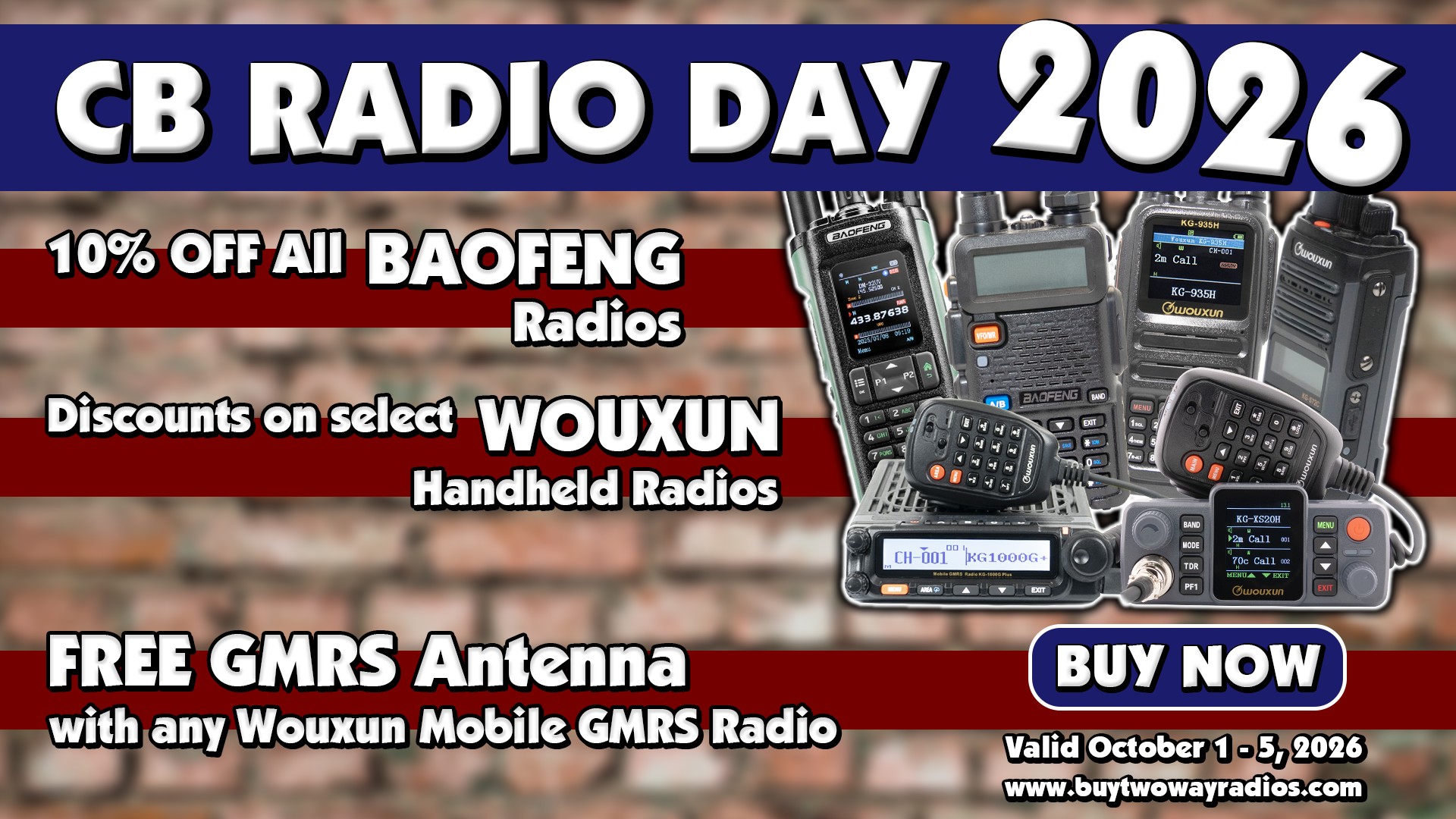
This promotion expired October 5, 2026 and is no longer available.
CB Radio Day 2026 is here, and we’re celebrating with special discounts and freebies on select CB, GMRS and Ham radios!
Every October, radio enthusiasts recognize a date that has become part of CB radio history. October 4, or 10-4 Day, celebrates a communications service that has been used for decades by truckers, travelers, hobbyists and anyone who appreciates the convenience of short range radio communication.
What is CB Radio Day?
On October 2, 1978, President Jimmy Carter proclaimed October 4, or 10-4, as National CB Radio Day. In the proclamation, he recognized the important role CB radio played in emergency communications on and off the road, as well as its contribution to public safety. Read more about National CB Radio Day!
To celebrate 10-4 Day this year, we’re offering these special deals during our CB Radio Day 2026 Sale!
- $10 Off a Wouxun KG-S72C Portable Handheld AM/FM CB Radio
- 10% off all Baofeng Radios
- $10 off KG-935G Plus Portable Handhed GMRS Radio
- $20 off a KG-935G Plus 2-Pack
- Free Wouxun Mobile GMRS Antenna when you buy a KG-XS20G Plus, KG-XS30G or KG-1000G Plus Mobile GMRS Radio
Also, when you buy a Wouxun KG-S72C CB radio you get a FREE CB Radio Quick Reference Card with your purchase!
There is no purchase limit, and no promo code is required. Simply add the qualifying products to your cart and the discount or free item will be applied automatically.
The CB Radio Day 2026 Sale ends October 5, 2026, while supplies last. No rain checks.
Happy CB Radio Day 2026![related_products is_auto_added="1"]
This promotion expired October 5, 2026 and is no longer available. CB Radio Day 2026 is here, and we’re celebrating with special discounts and freebies on select CB, GMRS and Ham radios! Every October, radio enthusiasts recognize a date that has become part of CB radio history. October 4, or 10-4 Day, celebrates a communications […]
Have you ever wondered why radio signals become weaker over distance, or why adding a long length of coaxial cable can reduce your radio's performance? The answer often comes down to attenuation.
In this episode of Radio 101, Tommy explains what attenuation is, how it may occur and how to minimize it to improve radio performance.
Want more videos about 2-way radios? Browse our video blog and subscribe to our YouTube channel!
[related_products is_auto_added="1"]Have you ever wondered why radio signals become weaker over distance, or why adding a long length of coaxial cable can reduce your radio’s performance? The answer often comes down to attenuation. In this episode of Radio 101, Tommy explains what attenuation is, how it may occur and how to minimize it to improve radio […]
 The Motorola CLS1410 has been one of Motorola's most popular business two way radios for many years. It became especially common in retail stores, restaurants, offices and other small businesses because it is compact, lightweight and easy for employees to use. it's still very popular today.
That popularity also means the CLS1410 has been around for quite a while. First introduced in 2003, the CLS1410 has been on the market for almost 25 years! Business radio technology has continued to advance, and there are now many radios with more power, digital operation, larger channel capacities and features that simply weren't common when the CLS Series was introduced. Yet, this little radio is still on the market and on the air.
That doesn't mean the CLS1410 is obsolete. In fact, its simplicity remains one of its biggest advantages. The radio provides four programmable channels and a selection of 56 UHF business frequencies without burdening employees with a lot of additional features they may never use. For a retail store, restaurant, office or other smaller operation that just needs basic voice communications, that can be exactly what is required.
The CLS1410 is also very small compared to many traditional business radios. Employees can clip it to a belt or carry it throughout a shift without having a large radio getting in the way. The controls are straightforward, which makes it easier to put radios into the hands of employees who may have little or no previous experience using two way radios.
Another reason the CLS1410 continues to make sense is its compatibility with existing systems. There are a lot of CLS Series radios already in use. A business that has relied on them for years may not have any compelling reason to replace an entire working radio system just to gain features it doesn't need. Adding another CLS1410 or replacing a worn unit can be a much simpler solution.
For a completely new system, however, it is worth looking at the other options available today. More powerful analog radios may offer better coverage for larger facilities, while digital business radios can provide additional channel capacity, clearer communications and other capabilities that may be useful as a business grows. The right choice depends on the size of the operation, the environment in which the radios will be used and the features employees actually need.
The Motorola CLS1410 has lasted as long as it has for a reason. It is a simple, compact business radio that has served retail stores and small businesses well for many years. It may no longer represent the latest business radio technology, but for an existing CLS system or an application where simplicity is more important than advanced features, it can still be a practical choice.[related_products is_auto_added="1"]
The Motorola CLS1410 has been one of Motorola’s most popular business two way radios for many years. It became especially common in retail stores, restaurants, offices and other small businesses because it is compact, lightweight and easy for employees to use. it’s still very popular today. That popularity also means the CLS1410 has been around […]
One of the advantages of using repeaters is that they can significantly extend the range of radio communications. But what if you could connect multiple repeaters together and communicate across an even larger area?
That's where linked repeater systems come in.
In this episode of Radio 101, Tommy explains what a linked repeater system is, how it works and who uses them for two way radio communications.
Want more videos about 2-way radios? Browse our video blog and subscribe to our YouTube channel!
[related_products is_auto_added="1"]
One of the advantages of using repeaters is that they can significantly extend the range of radio communications. But what if you could connect multiple repeaters together and communicate across an even larger area? That’s where linked repeater systems come in. In this episode of Radio 101, Tommy explains what a linked repeater system is, […]